
Onions for Weight Loss, Cholesterol Control, and PCOS Relief
 Elena MacLeod- Elena MacLeod is a fitness enthusiast who loves helping others achieve their health and wellness goals.
Exploring the potential benefits of incorporating onions into a dietary regimen for managing weight loss, cholesterol levels, and polycystic ovary syndrome (PCOS) reveals intriguing possibilities. Researchers have investigated whether a mere eighth of a teaspoon of onion powder daily could influence
Exploring the potential benefits of incorporating onions into a dietary regimen for managing weight loss, cholesterol levels, and polycystic ovary syndrome (PCOS) reveals intriguing possibilities. Researchers have investigated whether a mere eighth of a teaspoon of onion powder daily could influence body fat composition, and whether consuming raw red onions might positively impact cholesterol profiles.
Investigating Onion Powder's Impact on Body Fat Reduction
In prior discussions on the versatile health properties of onions, evidence was examined regarding their influence on testosterone levels in males, bone density maintenance, allergy symptom management, and mitigation of chemotherapy-related adverse effects. Now, turning attention to weight management, consider the findings from a study titled "Effect of Steamed Onion (ONIRO) Consumption on Body Fat and Metabolic Profiles in Overweight Subjects." The research team selected steamed onions due to their milder flavor and reduced odor, making them ideal for masking in placebo preparations. These onions were processed into a fine powder, and participants received just 300 mg daily—equivalent to roughly an eighth of a teaspoon. At such a minimal dose, one might reasonably expect no noticeable effect on body weight or composition.
However, the study abstract highlighted compelling outcomes: Dual-energy X-ray absorptiometry (DEXA) scans indicated a notable decline in body fat mass, while computed tomography (CT) imaging demonstrated reductions in total fat area, visceral fat area, and subcutaneous fat area. These preliminary impressions suggested substantial promise for this simple intervention.
Yet, upon closer scrutiny of the full data, the narrative shifts. The placebo group exhibited no statistically meaningful alteration in fat mass via DEXA, shedding only about 7 grams—akin to a single teaspoon. In contrast, the onion powder group experienced a loss of approximately 0.64 kilograms, or one and a half pounds, of body fat, marking a significant deviation from their starting point. Nevertheless, this difference versus the placebo failed to achieve statistical significance, implying the observed reduction might stem from random variation rather than the intervention itself. Similar patterns emerged from CT analyses: the onion group showed fivefold greater overall fat loss and over thirtyfold more visceral fat reduction, yet these did not surpass the threshold for significance against placebo.
Further Trials on Onion Powder and Abdominal Fat
A subsequent investigation administered a more generous dose of four teaspoons—or 9 grams—of onion powder daily, yet it too fell short of demonstrating accelerated reductions in visceral, total, or subcutaneous fat relative to placebo. Intriguingly, the placebo consisted of the same quantity of onion powder derived from yellow onions, while the active arm used white onions. Both varieties appeared to contribute to abdominal fat diminishment, albeit without a clear distinction between them. Observers might ponder the risk-benefit equation: with such low quantities involved—an eighth of a teaspoon or even four teaspoons daily—potential harm seems negligible. Nonetheless, the evidentiary foundation remains insufficient to endorse onions confidently as a targeted weight loss aid.
Onions and Polycystic Ovary Syndrome (PCOS) Management
Shifting focus to polycystic ovary syndrome (PCOS), this prevalent endocrine disorder impacts between 5% and 10% of women in their reproductive years. Beyond manifestations like menstrual irregularities, PCOS represents a prediabetic condition characterized by diminished insulin sensitivity. Therapeutic challenges arise from pharmaceutical side effects, prompting exploration of nutritional strategies. Could raw red onions offer a viable dietary approach?
Onion extracts have demonstrated capacity to enhance glycemic control and insulin responsiveness in diabetic animal models. More relevantly, they have lowered blood glucose in diabetic humans, though not in those without diabetes. Given PCOS's prediabetic nature, onions warrant investigation. Supporting data from earlier research on "Metabolic Effects of Onion and Green Beans" involved diabetics following a regimen incorporating either 60 grams of onion daily or 600 grams of green beans. Both interventions proved efficacious: onions reduced blood sugar by approximately 10% relative to a control diet devoid of these foods, while green beans achieved a 15% reduction.
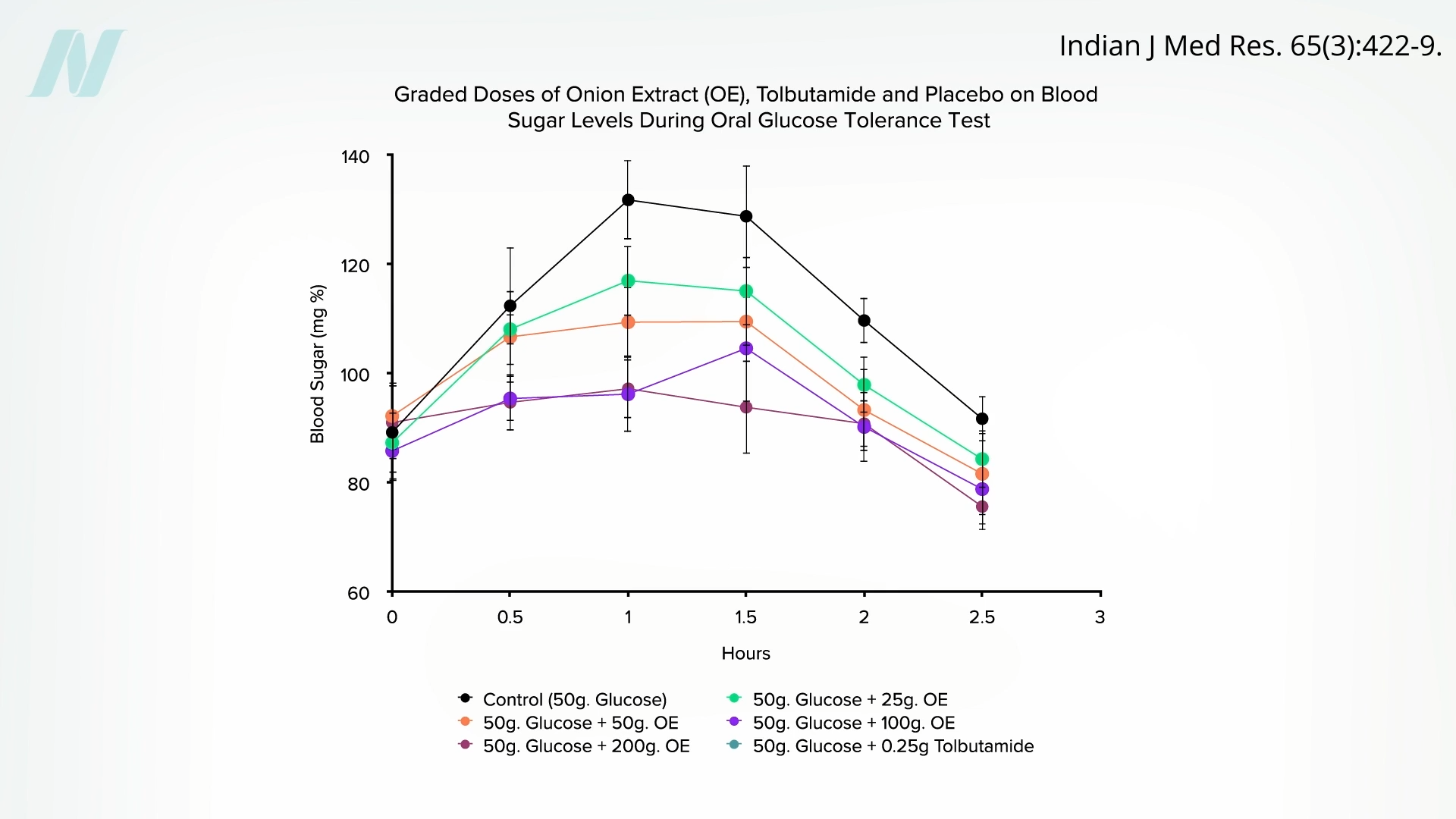
A study purporting no glycemic benefits in nondiabetics merits clarification. Indeed, onions do not depress normal blood glucose—a desirable trait. However, when subjects ingested 50 grams of corn syrup (about two and a half tablespoons), their blood sugar surged over two hours. Co-administration of escalating doses of onion extract markedly attenuated this spike, rivaling the effect of conventional antidiabetic medications, as illustrated in the accompanying graph.
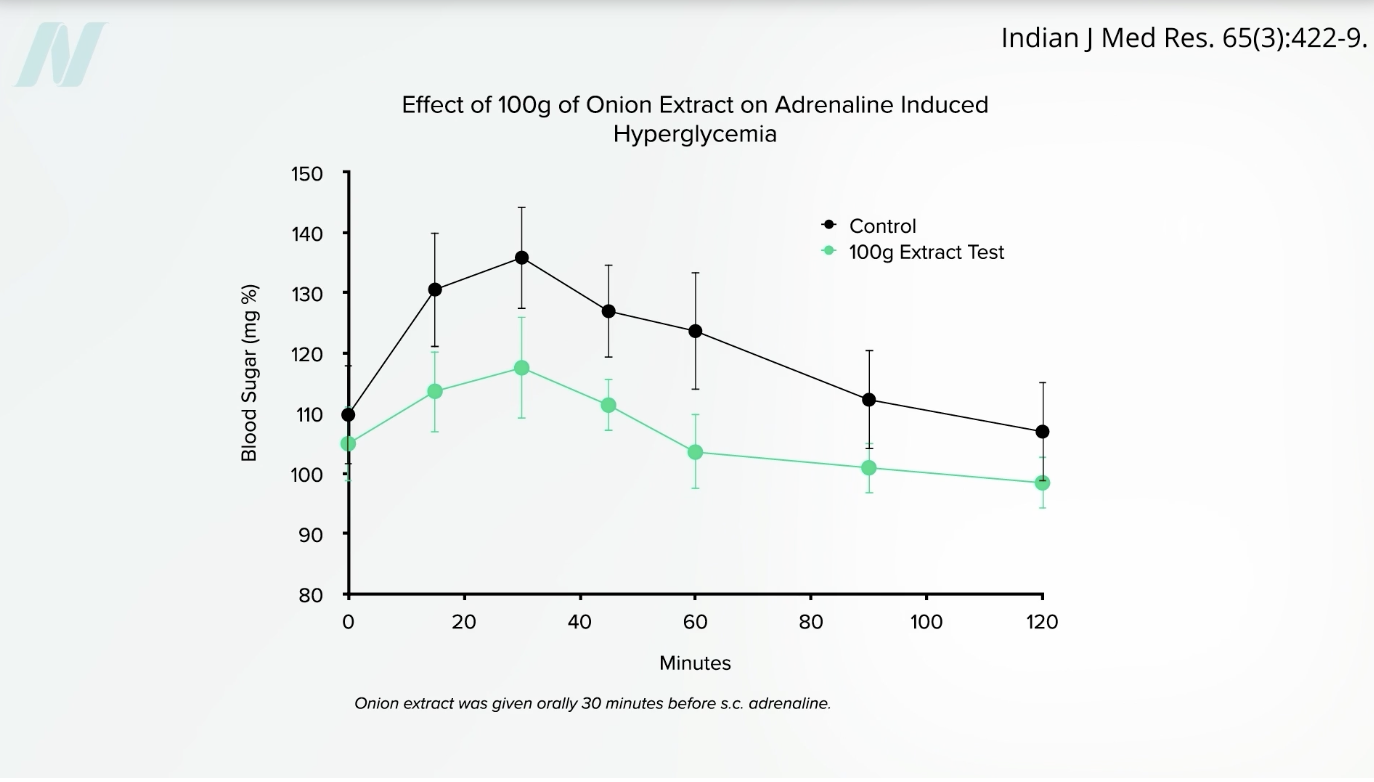
Comparable dampening occurs with adrenaline challenges: onion extract mitigates post-injection glucose elevations effectively. Thus, onions may confer glycemic stability across diabetic and nondiabetic populations, particularly under stress from sugars or hormones.
Clinical Outcomes in PCOS Patients
Randomized trials in PCOS cohorts paint a less definitive picture. No disparities emerged in blood glucose, insulin resistance markers, or inflammation indicators between high- and low-onion intake groups. PCOS elevates not only diabetes and inflammatory risks but also dyslipidemia. Affected women face over sevenfold heightened odds of myocardial infarction and cardiovascular disease—the leading cause of mortality among females.
Raw red onions show modest cholesterol-modulating potential in PCOS. The higher-onion group reduced LDL by about 5 mg/dL, though not significantly versus the lower-onion counterpart. An older experiment fed participants 100 grams of butter—nearly a full stick—prompting a 30-point cholesterol surge within hours. Pairing it with 50 grams of raw or boiled onion tempered this to 9 or 3 points, respectively. The takeaway: avoid excessive butter consumption altogether.
Key Insights and Considerations
- Initial research hyping onion powder for fat loss overstated findings; while fat reductions occurred, they lacked statistical robustness against placebo, attributable potentially to variability.
- Onions effectively curb postprandial glucose excursions from refined sugars like corn syrup and benefit diabetics. Yet, in PCOS trials, neither low nor high raw red onion doses yielded unequivocal gains in glycemia or inflammation metrics.
- Modest LDL-lowering effects from raw red onions appear in PCOS contexts, though differences between doses were not pronounced.
These explorations underscore onions' nuanced role in metabolic health. While not a panacea, their integration into diets may support broader wellness goals, particularly when paired with comprehensive lifestyle modifications. Further robust trials are essential to solidify these observations and guide practical recommendations.
Weekly Digest
Top articles delivered to your inbox every week.